Showing posts with label history. Show all posts

Thursday, January 20, 2011

A long weekend in Barcelona, part 2

All right, the second day falls to me. No random photo today, as this post will be epic enough as it is.

After forgoing our original plan for a short run in favor of sleeping in, we headed out into another day of sunlight with plans of getting breakfast at the world-famous Mercat de la Bocqueria, which Danny neglected to mention we spent bunch of time drooling over the day before. But we were still quite full from dinner the night before (see photo of glistening pan of cheese in post below), so we headed back into the old city to explore the old Jewish Quarter, or Call. Obviously, all the Jews of Spain (my ancestors!) were kicked out in 1492 after living there for centuries, but the Jews of Barcelona mostly left after riots in 1391 (for more information, check out this quick review), and it seems that the city has only recently begun excavating some areas of the ancient Jewish neighborhood. We looked in at the ancient "Major Synagogue" that was excavated in the 1990's, bits of which are through to date back to the 1st century. You can see some good photos and read more information from the Call Association of Barcelona. Then we went to the small but informative Call interpretive center, where Danny was pleased to discover that he could mostly understand a Spanish exhibition on Shlomo ben Adret, a Medieval rabbi.

I should add that even though we were still full from dinner, we did manage to find room for a "breakfast" of chocolate churros that we purchased from a hole-in-the-wall churreria. And all I can say is, I fear for what would happen to my coronaries if we lived near this place. They were somehow chocolately, sugary, crispy and chewy all at the same time. We munched on them happily as we walked around the quiet, narrow streets of the Call. And on that note, it was almost spooky how quiet and chilly it was in this neighborhood. The streets are extremely narrow and winding, and the stone buildings rise 3 stories on either side, so almost no sunlight or noise seems to penetrate, at least in the morning. So it was quite a jolt to emerge from this neighborhood onto Passeig de Gràcia (see photos of Danny for instructive difference).

This day, we had decided, was to be our main Antoni Gaudí day, so from here we headed up Passeig de Gràcia, a wide street lined with orange trees and sidewalk cafés, to scout out some of Gaudi's famous houses before arriving at our final destination, the Sagrada Família. We feasted our eyes on Casa Batlló and Casa Milà and enjoyed the feeling on sun on our backs. After a quick lunch up in the perfectly-gridded and stately neighborhood of Eixample, we emptied our wallets to see the inside of Sagrada Família, Gaudi's most famous, though unfinished, creation. I won't go into the whole history (why should I when Wikipedia has already done it for me?), so I'll just stick to our opinions. I thought it was awesome. I loved the stark, raw emotion of the Passion façade. I wasn't as big a fan of the chaos of the Nativity Façade, but it reminded me of drip sandcastle, so that was cool. And the inside...to me that was the best part. The canopy of tree-like columns, the unbelievably bright colors streaming through the stained glass at sunset, the lack of anything gold-encrusted, it was all great. I also love catching glimpses of it from all over the city, towering over everything else...like a 7-tier wedding cake sitting in the middle of a table of cupcakes (not that there's anything wrong with cupcakes!). We'll have to go back in 30 years to see it when it's completed! Danny, ever the historian, also points out that seeing an unfinished cathedral is really nothing distinctive. All of the enormous, medieval cathedrals we take for granted today were, for long periods of time, unfinished simply because they took so long to build. So by going to Sagrada Família we can start to imagine what it was like during the creation of those cathedrals. History is magic!


Okay, our hope was to complete the Gaudí tour with Parc Guell, but it was getting too late, so we settled for heading further north to the Gràcia district to explore and keep our noses open for more chocolat and churros. Gràcia used to be an independent town, and it certainly feels more maze-like and understated than Eixample. We stumbled into a lively square with a church on
one side and cafés on all the others, with a group of teenage boys kicking a soccer ball around the middle. It all felt very...Spanish. So even though there was no hot chocolate we decided to stay, and we settled for tea and a plate of patatas bravas. From there we ducked into a small wine bar that our book recommended, and my butchering of "tres creus" (the delicious red wine I ordered) prompted Danny to give me a helpful lesson in Spanish vowel sounds (bottom line: easier than French!).

From there we raced back to Granja Viader to try to get more hot chocolate before it closed, but sadly we were too late. After this disappointment, even though it wasn't even 9pm, we decided we were ready for dinner. After checking out a few menus, we settled on L'Antic Forn (the old oven), mostly because they advertised Calçots, which we had read about in our guidebook. Basically, these are large scallions/small leeks that are seasonal in this region and consumed "in massive quantities" from January-March. The traditional way to serve them is battered and fried. So we obviously ordered these (turns out they are also served with a spicy, creamy sauce!), and rounded it out with Spanish omelette, a veggie pizza for Danny and a plate of spinach with raisins and pine nuts for Becca. So full, but so worth it!

Tuesday, January 18, 2011

A long weekend in Barcelona, part 1

Following the advice of countless friends, we spent last weekend in sunny Barcelona.  After the gray gloom of the London winter, it was lovely to feel the sun’s rays for a few days.  Here’s a rundown of how we spent our time there.

Day 1

Compared to some of other early departures, this one was relatively leisurely.  An 8:45 flight out of Luton might sound bad, but there’s a train from Kentish Town which makes it a snap.

By the time we arrived in Barcelona, met the Australian-Catalan hotel manager who used to live in Coolidge Corner, and settled into our room, it was the traditional Spanish lunchtime, i.e. 2 PM.  As you might know, Spanish cuisine is heavy on… pig.  So we were slightly anxious about how we’d fare.  Fortunately, we had some vegetarian restaurant recommendations, including L’Hortet.  My Spanish is decent, but my Catalan is non-existent, so we were very appreciative of the waitress who patiently translated the menú del día into English for us.

DSCN5481

Fideos!  Or ‘fideus’ in Catalan.  They were different from the crunchier fideos they serve at Oleana, but that’s a garlic sauce you see on top, so this was delicious.  As was the kefir (a thick, fermented yogurt) and crème catalan we had for dessert.

Our standard practice on arriving in a new city is to wander, somewhat aimlessly, to get a sense of how it all fits together.  So it was down La Rambla to the Monument a Colom (Columbus returned to Barcelona after his first voyage).  Then we walked along the waterfront for a bit, which provided the perfect opportunity for the obligatory photo in front of boats.

DSCN5493

Next up was working our way through La Ribera towards Santa Maria del Mar.  Our guidebook said it was built about 60 years ago, but when you step inside, you quickly realize that the guidebook is wrong.  Twentieth-century churches rarely look like this:

DSCN5498

DSCN5503

Looks a lot like a Gothic church to me.  Here’s the actual story: the church was built in the 14th century (though an earthquake in the 15th century made reconstruction necessary).  In 1936, during the Spanish civil war, anti-clericalists set fire to the church and destroyed much of the interior decoration.  As a result, the interior these days is rather stark.

For what it’s worth, now seems as good a time as any to comment on the almost complete exclusion of Spanish (and Portuguese, for that matter) history from ‘mainstream’ historical scholarship on modern Europe.  I’m trained as a modern Europeanist, but I’m fairly certain that at no point in that training did I read a single book or article on Spain, and I have a feeling I’m not alone in that.  I haven’t thought too much about why this should be the case, but I’ve always been struck by this rather strange collective ignorance of a rather significant chunk of Europe.

“Enough of the historiographical critique!” you say.  Very well.  How about some photos of hot chocolate, then?

DSCN5512

That’s more like it!  In Spain, people don’t have dinner until late in the evening, so we needed to tide ourselves over with something a little sweet.  It’s hard to get much better than hot chocolate and churros at Granja Viader, which has been serving them up (along with other milk-based goodies) since 1870.  Spanish hot chocolate is famous for being so thick that it’s almost a pudding – that spoon you see on the saucer is as much for eating the chocolate as it is for stirring in sugar to cut the bitterness.  I was still getting into the swing of things in terms of actually communicating in Spanish, so the giant dollop of whipped cream was a bit of a surprise, though by no means an unwelcome one.  As for the churros, let’s just say I have another weapon in my arsenal to break down Becca’s defense against us getting a deep-fryer someday.

Between the walking, the chocolate, and the churros, we were pretty exhausted by this point, so we went back to our room to take a nap before dinner.  After walking around L’Eixample a bit, we settled on Úbeda, in large part because their menu had 1) English translations and 2) lots of tasty-looking vegetarian tapas.  We weren’t expecting to have to make many actual choices at restaurants in Spain, but Úbeda provided the opportunity.  We settled on baby leeks gently cooked in rosemary oil, little (fava?) beans in an oil and mint sauce, a mixed salad with walnuts, fig jelly (which I studiously avoided), and goat cheese and, the pièce de resistance, melted provolone and oregano.  It was all so good that I forgot to take a photo until we were halfway through.  Note how the provolone is still glistening on the left.

DSCN5514

Then it was off to bed to get as much sleep as possible for a busy Saturday, which Becca will tell you all about in the next post.

Sunday, January 9, 2011

Happy New Year!

Happy 2011, everyone!

Unfortunately for you internet addicts out there, our new years resolution was clearly not to blog more often, seeing as we're over a week into the 2011 and we haven't blogged once. So I thought I'd give you a quick update on what we've been doing. But first, RPOTD:

We had dinner with our landlords, and I made this French apple tart for dessert. Recipe is here, on Joy of Baking.com. It was nice and apple-y, not overwhelmed with sweetness or buttery-ness.

So let's see....unmentioned activities of late have included a Boxing Day rugby match at Wembley, courtesy of our friend Lianna who won the tickets in a raffle. It was the Wasps vs. Saracens, both of which are London teams. Because it was Boxing day, and because there were musical entertainers as well, the atmosphere was more family-friendly than rowdy, though it was so cold I wouldn't have been upset if someone had started a bonfire in the stands. We also discovered that although we know the general game-play of rugby, the individual rules about fouls are beyond us, plus it's pretty hard to see what going on in the middle of a scrum or ruck, so there were some parts of the game when we got a little lost. But overall it was a good time, and during halftime a member of the audience, participating in a classic half-time kick challenge, hit the crossbar from about 30 yards out, winning £250,000. amazing! For anyone who is interested, Saracens won 13-6.

Between Christmas and New Years there wasn't too much going on, but we did have the pleasure of getting together with two other expat Swatties, Ele and Jeff, who have recently moved to Oxford. We checked out the Christmas market at Hyde Park, which was bigger than the market in Scotland and had more rides, but it was somewhat lacking in charm (since when are haunted houses traditional Christmas entertainment?). But it was not lacking in warming beverages and french fries in paper cones, so it was overall a good experience. Then we went to the Tate Britain (British art from 1500), which is most famous for its collection of paintings by JMW Turner, and we managed to get about halfway through before museum-foot set in. Then Ele and I did a lot of reminiscing about playing soccer and lacrosse at Swarthmore, and we all headed home to put our feet up.

New Years Eve proceeded in typical New Years Eve party fashion, except this one included a German brother-of-a-friend-of-a-friend setting off fireworks in our host's backyard, which was exciting. We spend the next day recovering and making an enormous pot of veggie chilli.

The next day we got together with another Swattie, yay! Our friend Abigail, who is currently working for the US State Department in an undisclosed location (okay, it's Jordan, but isn't it cooler to think it's top secret???) decided last minute to come to London with her "beau", and we met up with them at the British Museum to catch up and look at old things. The British Museum is really an amazing collection of artifacts from all over the world...some possibly ill-gotten marble statues from the Parthenon, a huge supply of Egyptian mummies, and piles of ancient coins and armor and pots that were literally found in people's backyards all over England.

After the British Museum we split up - Abigail and Tony went to the Tower of London, and we'd both already been there - and we got lunch in Covent Garden then went to the London Transport Museum, which is way more awesome than it sounds (although admit it...to a lot of you this sounds really awesome). I'll spare you the details on the history of the Tube and the bus (short version...when the bus first started it was pulled by horses, and they shat a lot), but here are some cool images we came across.


The first is a sketch of Archway in 1823, which is now a busy tube station and bus interchange right near where we live, and the other is essentially an advertisement from 1907 for our neighborhood and surrounding "suburbs", which are now soundly in the middle of London.


Last week was just a usual work week. Danny went to the archives and I went to my office at the LSHTM. I thought a lot about keywords and journal databases, and Danny thought about religious broadcasting on the BBC. We cooked vegetables.

Oh! just kidding, last week was not just a usual work week...it was the week that England won The Ashes in Australia for the first time in 24 years! And they didn't just win, it was an absolute crush job. So last week was a bit of a blur, because the matches didn't start until 11pm GMT, and we stayed up late watching every night. And I killed time before they started by engrossing myself in Pride and Prejudice (yay for old classics free on Kindle!) and The Magicians, an "urban fantasy" book that John lent me when I was back in Boston. Kind of a Harry Potter meets Narnia, but set in the US, and with sex and drugs. A fun and engrossing read.

This weekend we furiously set about trying to check things off our ginormous list of things to do in London. Places we hit up:

Apsley House, former residence of the 8 Dukes of Wellington, that now has an impressive collection of things and artwork that were given to the Dukes over the years. Basically, the first Duke of Wellington defeated Napoleon on multiple occasions, which caused most nation-states of Europe to shower him with riches. Highlights of the collection included a sword that belonged to Napoleon, The Waterseller of Seville, and multiple detailed, if inaccurate, paintings of the Battle of Waterloo.

Harrods. Again. But this time we were drawn there by some gift certificates we each had. Plus there are massive sales going on in every store in London at the moment, so this is the one time of year we can actually afford anything there. I got some cute green shoes and Danny got a luxurious cashmere scarf.

The Brick Lane/Shoreditch area. This was today's expedition. Our original intention was to check out some of the markets and shops in this artsy neighborhood, as well as one or two small museums that are in the area, but we got a late start and were totally overwhelmed by the markets, so we decided to save the museums for another day. We started with Old Spitalfields Market, which hosts dozens of stalls of funky clothing, old books, and hand-crafted jewelry and accessories, all surrounded by restaurants and cafes. I got a skirt that has owl-printed fabric in the pleats (bird-patterned clothing purchase number two of this year!), and I bought it directly from the designer/maker, which was cool. Next we checked out the Christ Church Spitalfield's, which was built in the mid-18th century in an effort to provide more churches to the "godless" immigrants who were rapidly filling London's east end. Funny how Christians always thought of Jews as godless...

Our next destination was Brick Lane Beigel Bakery, which was just a few blocks up Brick Lane, but it took us about 45 minutes to get there because we were drawn in by lots of used clothing shops, artisanal tee-shirts booths, and stands selling fresh noodles and veggie buns. Danny searched for a classy jacket that would fit his shoulders properly, but alas. Also, I've also never been accosted by so many people advertising their curry houses. The beigel (yes, that's how they spell bagel) shop was a bit disappointing...it's supposed to be one of the best in London, but the bagels just tasted like a Lenders bagel. Oh well...we'll be back to Kupel's in a few months! Then we spent some time exploring the side streets and seeing the Columbia Road flower market close up for the day. Overall the neighborhood has some cool little shops (including one where we bought some Sicilian oranges and home-made jam), but I wouldn't describe it as "gentle", as this New York Times article did.

Okay, I think that just about brings us up to speed. And speaking of speed, in case you didn't know, Danny and I are running a half-marathon in June when we get back to the states, so we've also been running a lot lately. Expect some running-focused blog posts in the upcoming future! Here's a running-related photo to tide you over:


Self-inflicted by repeated kicking, or tendon re-attatchment surgery? You be the judge...

Sunday, November 21, 2010

Churches, Chipotle, and Canaletto

With Becca back in the US securing gainful employment, I’m on my own for the next few weeks here in London.  I’ve mostly just been feverishly working away, but I took yesterday to do some things that Becca probably wouldn’t be all that interested in.  There is, of course, a limit to the number of churches I can drag her along to without prompting a few complaints.

But before I went on my church-hunting expedition, I checked out the exhibit at the National Gallery on Canaletto and his Rivals (come to think of it, a collection of nothing but vedute of 18th-century Venice might also qualify as something of a niche interest of mine).  If you’ve ever seen a painting of Venice (like this one, say), you’ve seen Canaletto, or one of his innumerable imitators.

Assuming you like Venice (it has its detractors, I know), it’s hard not to instinctively like Canaletto’s paintings.  “Look!  It’s Venice!  Just like I remember it!”  This reaction probably has more to do with the fact that Canaletto played a large role in creating what our mental image of Venice is, but no matter.  He seems to capture something of the essence of the city – the brilliant sun illuminating the Rialto, the gentle list of gondolas on canals, and all the rest.

And that’s fine, as far as it goes.  But after half a dozen pretty pictures of canals with St. Mark’s in the background, it starts to get a bit tiresome.  So I was rather hopeful about this exhibition – perhaps it would rekindle my appreciation for Canaletto?

Well, I have to say it didn’t, though it did its very best to convince me of his genius.  If anything, I came away with an even more diminished opinion of him.

That certainly wasn’t the curators’ intent.  Though the audio tour wrap-up insisted that the main point of the exhibition was to demonstrate the variety of ways that painters depicted Venice, the real argument, implicit throughout, was more along the lines of “Look at how Canaletto vanquished all his rivals!”  This might have just been for the sake of marketing – I don’t expect that many people would turn out to an exhibition extolling the virtues of Bernardo Bellotto or Michele Marieschi.  But as the review by Charles Darwent in the Independent notes, it simply treats Canaletto’s work as the norm.  It’s undoubtedly the case that Canaletto set the standard for 18th-century Grand Tourists – there’s a reason why so many works by other painters were sold under his name.  But that doesn’t mean that we have to accept that aesthetic judgment today.

Seeing his work juxtaposed with the alternatives, it’s hard to avoid the conclusion that Canaletto was a sell-out.  A technically proficient sell-out, to be sure, but a sell-out all the same.  He grasped what English buyers wanted and he gave it to them.  And it wasn’t simply a realistic depiction of the Venice they had come to love.  Instead, compared with other works by some of his supposedly vanquished rivals, Canaletto’s present a rather whitewashed, excessively sunny view of the city.  Even his clouds seem to glow.  If you were using his paintings as documentary evidence for the condition of Venice in the 18th century, you’d think think that the decayed grandeur we so often associate with the city now was an entirely modern phenomenon – every building seems in pristine condition (at least during his mature period; The Stonemason’s Yard, an early work, is much more interesting than any of his canal views).  But if you look at alternative depictions, there’s dirt and decay.  In other words, Canaletto was painting postcards with idealized views of the city for tourists.

That’s not to say there aren’t interesting paintings in the exhibition.  But they’re overwhelmingly from early or late in his life – before he gained fame or after he drifted back to relative obscurity.

So who comes out of the exhibition well?  Francesco Guardi, for one.  As this view of the lagoon makes clear, Guardi was interested in atmosphere in a way that Canaletto simply wasn’t.  At the risk of falling into the trap of favoring artists who seem to anticipate later developments, Guardi just feels far more modern than Canaletto.

I fear that I’ve probably exhausted the patience of my readers with these ruminations on 18th-century view paintings, so I’ll move on to the rest of the day.

St Martin-in-the-fieldsSo, from 18th-century Venice to 18th-century London, in the guise of St Martin-in-the-Fields.  There are classical music concerts virtually every day there, so I was fortunate enough to step in during the rehearsal for last night’s performance of Beethoven’s Fifth Symphony by the London Musical Arts Orchestra.  The apparent distortion in the window isn’t just an effect of the photo.  It’s a new window, from 2008, by Iranian artist Shirazeh Houshiary.  In addition to incorporating a cross, it also gives the appearance of melting before your eyes, not a bad artistic choice, given that the stained glass was bombed out during the war.  In short, I think it works.

St James's Piccadilly, interiorFrom St Martin-in-the-Fields, it was just a short walk to St James’s, Piccadilly, where yet another rehearsal was going on, this time by the London Orpheus Choir.  The light was starting to fade by this point, but there was enough for me to capture this photo showing the rather elegant Corinthian gallery resting on the rather stolid Doric base.  The church also has a really pretty baptismal font with Adam and Even that I somehow forgot to photograph.  Fortunately, thanks to the wonders of the internet, I can just link to one.


Next up on my list Immaculate Conception (Farm Street)was Immaculate Conception – you guessed it, a Roman Catholic church.  Let me tell you – Mayfair late on a Saturday afternoon is dead.  There were a few moments where I couldn’t see anyone else on the street I was on – this, when I was just a few hundred yards away from the crush of Oxford Street.  I did wander across a rather lively looking pub, but if you’re looking for a quiet stroll on the weekend in central London, you could do worse than just wandering around Mayfair.  As for the church, there was a wedding about to start, so I couldn’t get in.  In spite of its medieval appearance, it was only built in the 1840s.  Before the 19th century, England wasn’t exactly the most friendly place for Catholics – they didn’t receive civil emancipation until 1829 and there wasn’t anything resembling the standard Catholic hierarchy until 1850.  Catholic revival and Gothic revival went very much hand in hand.

All Saints, interiorMy final church visit of the day was up in Fitzrovia, so I wandered along Oxford Street for part of the way, enjoying some roasted chestnuts.  After crossing up to Margaret Street, I was once again struck by how quiet things can get when you escape the main shopping arteries.  So quiet, in fact, that I had about ten minutes all to myself in All Saints.  You’d be excused for thinking this was medieval, too.  In fact, it’s even later than Immaculate Conception (1859).  That’s right, more Victorian Gothic.  Though not, in this case, Catholic.  At least not Roman Catholic.  The Church of England is, as they say, a broad church, incorporating aspects of both Catholicism and Protestantism, with particular individuals and churches leaning in one direction or another.  All Saints falls firmly in the Anglo-Catholic camp, though this story (from the Wikipedia article on the church) nicely captures how the ‘Anglo’ part of that description remains important:

Fr Cyril Tomkinson (Vicar 1943-51), rebuking a visiting priest who asked for the use of the Roman Missal, said "the rule here is music by Mozart, choreography by Fortescue, decor by Comper, but libretto by Cranmer".

By this point, I was beginning to feel famished, so I made my way over to the sole Chipotle in London.  It was fantastic, as always.  They were especially generous with the guacamole, which can be a problem in particular branches back in the US. 

So there you have it: an afternoon and early evening in Westminster, complete with art criticism and lessons on 19th-century religious history and Anglican churchmanship.  Don’t worry, Becca will be back before you know it.

Thursday, September 9, 2010

Academia, England-style

Random Photo that Danny thought was funny:

Oxford may only be the 6th best university in the world (thanks, Stephen, for posting the link), but it's still an amazing place for a weekend trip and conference! Thanks to my cushy connections at the LSHTM, I got to attend a Health Policy conference earlier this week, held at Madgalen College in Oxford. The conference was Monday and Tuesday, but Danny and I headed out on Sunday morning to see just how Oxford compared to Cambridge (which, incidentally, just leaped over Harvard for best university in the world). Although the hands-down verdict is that Cambridge is better (I mean, who punts from inside the boat?!), we had a great time. Highlights of the visit included:

- Visiting Christ Church (which is a college, not a church, although it does have quite a large church), where some scenes from Harry Potter 1 and 2 were filmed, and where Charles Lutwidge Dodgson was inspired to write Alice in Wonderland. Alice was the young daughter of the dean of the college. Every night after dinner the dean would leave via a hidden door and back staircase - the white rabbit was based on him. Alice also had a cat named Dinah who would sit in a tree next to the library.

- Listening to bees. Just so you're assured that Oxford does have a hippy-dippy side, we visited a socio-ecological project where a guy has set up 2 bee hives, with a stethescope in each one so you can sit and listen to the bees doing their thing. It was pretty cool.

- Cream tea

- Dinner at one of Jamie Oliver's Italian restaurants. Tired of going to pubs and finding just one veggie option, we splurged for some home-made Italian goodness. And it was good.

- The Ashmolean museum: art and old things.

- The Museum of the History of Science. Lots of beautiful, hand-made astronomical tools that I don't understand, the original 1940 journal describing the use of penicillin (not that long ago!), several of Marconi's first radios, and a chilling display of the first anesthesia delivery system from the 1840's next to a bone-saw kit from the late 1700's. Ouch.


But it wasn't all fun and games and tea (although we did buy a new game, and we did drink a lot of tea). We were also there to learn. While Danny went to the Bodleian library to read the records of the conservative party, I began in earnest my foray into the social sciences. It was really great to think about the more large-scale aspects of health, rather than just how we treat diseases. Topics ranged from the fairly straightforward (do policies to include patients in safety efforts work, and what determines whether patients want to get involved) to the obscure-but-thought-provoking (focusing on social governance and the fate of all humanity rather than politial and economic gains).

The keynote address happened to be by Ted Marmor, on the recent health care reform in the US, and how we managed to get a "Republican style" plan that no republicans voted for (answer? US senate structure. and some other stuff). But he is hopeful that some of the new laws regarding private insurance may pave the way towards more universal, if not single payer, health care.

Another point that was driven home in this conference is that in the UK, health care policy changes all the time. Yes, the NHS has been in place since 1948, but they (politicians) feel the need to make some slight change every 2-3 years - changing the details GP contracts, changing public health priorities, changing the flow of money. All of which of course means that there's very little time to evaluate policies, and everyone does so under the assumption that they will just change in a few years away. And doctors have just gotten used to the idea that while the policies change constantly, once the dust settles they will go back to practicing medicine as usual. Whether that will be the case with the new White Paper, though, is anyone's guess. But more on that later. For now, it's off to Salzburg!

Tuesday, July 20, 2010

Two can play at this game: The History of Primary Care in the UK

I hope that many, many years from now, I will be remembered this way too:


This post falls under the "Remind me what you are doing in London?" category. While Danny is off in the archives, I will be working in the Health Services Research Unit of the London School of Hygiene and Tropical Medicine (henceforth known as The Trop). As many have pointed out, the name of this school is just dripping in colonial history (though to be fair, hygiene and sanitation improvements do more for public health than just about anything). My work will be on a "scoping study" of England, trying to see how general practitioners (GPs) and clinics are providing health-promotion and disease-prevention services. But more on my actual project when I start in August.

For now, I am doing background research on the history of primary care in the UK, how primary care is currently organized, what exactly the National Health Service does, etc. Today I was poking around the website of the Royal College of General Practitioners, which like all good British organizations, keeps great public records of its own history. One of the most interesting things was a collection of letters from the early 1950s, when the College was first starting to take shape. Apparently there were already Royal Colleges of several other specialties, like surgery and obstetrics, but general practice was always considered too mundane or antiquated to share this status. When a group of GPs got together and started floating this idea, they got some really nice letters from other GPs around the country, with very poetic descriptions of why general practice was such an important part of the medical tradition, and why a Royal College of GPs was so important.

From one letter: "It is not popular to insist among doctors that the GP is first and foremost a healer and that his primary aim is to restore wholeness or guide his patients towards health. Health may be undefinable, but is not difficult to recognise if present." And from another: "The general practice of medicine could at this present moment be standing on the threshold of an intellectual renaissance."

Interestingly, this call for the RCGP came about because of the creation of the NHS in 1948. The NHS dictated that GPs were all responsible for a health of a particular panel of patients in their geographic area, but did not allocate any funds for these doctors to meet the needs of their new patients. Underfunded and overworked, GPs started to deliver poor-quality care and became completely demoralized. They could not encourage any high-quality young physicians to go into the field, and there was some question of whether the profession would survive.

Sound familiar??? This is shockingly reminiscent of the "perfect storm" that Cambridge Health Alliance doctor Somava Stout talks about in a recent CNN interview. Lots of new patients getting insurance and entering the patient population (good!), but still difficult to attract young physicians to a career that involves piles and piles of paperwork and will not pay back their student loans in any reasonable amount of time (bad!). I don't think that primary care in the US will spiral like it did in the UK after the NHS came into being, but big changes in reimbursement, plus a culture change around medical education to re-invigorate medical students interested in primary care, are both necessary if we are going to weather this storm. Find out what Primary Care Progress is doing to help!

Saturday, July 17, 2010

The food and parks are all well and good, but remind me why you're in England?

Ah yes, the aforementioned professional reasons for spending this year in England.  What is it that a(n) historian does on a daily basis, anyway?  Well, it depends on the day, but I'll describe today's activities to give you some sense of how I'm going to be spending the majority of my waking hours in the next ten months.

First, a bit of historical background (you'll be seeing a lot of this on the blog, I'm afraid).  The Education Act of 1944 (sometimes known as the Butler Act) established a tripartite system of secondary education in England.  You don't need to know what "tripartite system of secondary education" means, but if you're curious, the Wikipedia page I've linked to provides the details.  More importantly for my project (and therefore this blog post), the Butler Act also mandated religious education in schools supported by taxpayer funds.  To be specific, the act requires that "religious instruction [...] shall be given in every county school and in every voluntary school."

So, how do you get from the Butler Act to me spending my day at the London Metropolitan Archives?  Well, as you've probably heard by now, one of the topics I'm exploring in my dissertation is the history of religious education in state-supported schools in England after the Second World War.  England (like much of Europe) is typically understood as far more secular than the United States, but in the area of religion in the schools, the links between church and state in Britain are taken for granted in a way unheard of in the United States.  While religion has largely been banished from American public schools, it is, by law, required in English schools that receive funding support from the state.  So one of the big questions I'm exploring in my dissertation is how Christianity continued to be inculcated in English students, even while few of them went to church on Sundays and even fewer of them endured the traditional form of Christian socialization: Sunday school.

As it turns out, religious education (RE) is one of the few topics for which there is (and has never been) a national curriculum.  In other words, each local education authority (Americans, think: school board) determined on its own what RE would look like in its schools: what teacher qualifications to require, what students would learn about religion, and the like.  So if you're interested in the history of RE in postwar England, you have to look at what was occurring in individual local education authorities.

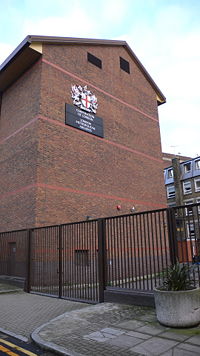
And that (with only four paragraphs of prelude!) is what I was doing today at the London Metropolitan Archives.  The main archives for the City of London and its surrounding (and ever-increasing) metropolis (see Becca's recent post for an overview of "What is London?"), the LMA holds the records of the Inner London Education Authority, which, from 1965 to 1990, was responsible for education in Inner London from 1965 to 1990 (before 1965, the London County Council held that responsibility; after 1990, each individual borough took over the administration of education within that borough).  Within the ILEA, the Standing Advisory Council for Religious Education (SACRE) was, you guessed it, responsible for the provision of religious education.

So I spent today (and will spend many more days) trawling through the records of the Standing Advisory Council for Religious Education of the Inner London Education Authority, trying to find the evidence that will help me answer a few key questions:

- How did religious education in London change in the decades after the Second World War?
- What forces were responsible for those changes?
- How should we understand those changes within the broader history of religion in twentieth-century Europe, which is typically understood as a history of crises and decline?

Today was a meaty day, as archival days go: the SACRE minutes.  Virtually every page of those minutes could turn out to be significant for my dissertation, so I had to pay close attention.  Or I would have had to pay close attention if I were actually taking notes.  Instead I decided (since virtually every page of those minutes could turn out to be significant for my dissertation) to photograph almost every page I looked at today.  Different historians take different approaches to taking photographs in the archives.  When it comes to sources (like so many other things!), I'm something of a completist: if there's any chance I'll find it useful, I'm making a record of it.  So I basically spent six hours today photographing as many documents as possible.

Even while racing through the files, though, I still took the time to skim through the documents for particularly juicy bits of information.  Today's haul drove home for me a key point about historical scholarship: any number of stories could be told using the evidence from a given set of sources.  I'm expecting to use these sources to tell a story about how the growing presence of religious minorities in London after the Second World War forced members of the Standing Advisory Council on Religious Education to adopt a more pluralist model of religious education.  But you could just as easily use these sources write a history of local government or a history of the relations between the Church of England, the Free Churches, and the Roman Catholic Church.  The basic point here is that historical sources do not speak for themselves.  They're the detritus of human existence and tell no story on their own.  It is only when historians come along and try to make sense of them that they seem to cohere into an intelligible narrative.

And that is a daunting task.  Some time next summer, I'm going to start to systematically work my way through what will by then amount to thousands of photographs of sources.  Some of them as seemingly banal as the one on the left asking the catering manager to bill a lunch to the proper budgeting code.  And others as telling as the letter I found last summer in which a Jewish woman complained to the London County Council that the school that employed her was prohibiting her from teaching religious education on the grounds of her religion.  It's that kind of source that can be more revealing that dozens of policy papers or committee minutes.  But you don't realize the significance of sources like that until you've immersed yourself in the documents and read each of them carefully.

For those of you who followed the hellish-ness that was my preparation for my preliminary exams last fall, I'd point out that what I'm doing now is virtually the exact opposite of what I did then.  In preparing for my prelims, I raced through 300 books, reading the introduction and conclusion carefully and, in some cases, doing little more than glancing at the body of each book.  The whole point was to grasp as quickly as possible what each historian was trying to say.  Here, I need to take my time with the sources.  They might be trying to tell me something, but it's ultimately up to me to put all the pieces together.  But for now, I'm just trying to find all the pieces.