Friday, October 15, 2010

Cows are to Oxford as Christianity is to Britain

At the beginning of September, Becca and I went to Oxford, she for a conference on health policy, me to check out some records of the Conservative Party related to religious education. But in addition to the professional activities, we also took some time to wander around town.  As we strolled along the maze of streams surrounding the city center, we came upon what might seem an odd sight in a city of 150,000: cattle.  Not many of them, but there they were.

This got me thinking about my dissertation (Tim Burke’s right: after a few years of grad school, nearly everything gets you thinking about your dissertation).  And what I came up with was this analogy: Cows are to Oxford as Christianity is to Britain.

No, seriously.  There are parallels here.  Cattle and Christianity are both marginal these days (literally in the case of the cows – they’re on the outskirts of the city).  If you were to start from scratch, you’d never think of grazing cows in the fields surrounding Oxford or establishing the Church of England as the state church.  Oxford’s economy is, these days, based largely on tourism.  Just 15% of British adults attend church on a regular basis.  It’s safe to say that Oxford is no longer an agricultural market town or Britain a solidly Christian country.

Yet… they’re there.  They're there because they were there in the past, and certain things stick around beyond what seems to be their natural or rational lifespan.  Path dependence is a crucial fact for understanding the world around us.  Simply put, history matters.

The difficult thing is figuring out the significance of these strange holdovers, these things that don’t quite make sense.  In some cases, like the cattle of Oxford, I’d readily admit that the significance is pretty minimal.  The cows are part of the ambience of the place, reminding visitors of Oxford’s agricultural past.  Along with certain architectural details in the city, the cows create a sense that Oxford is a place of the past, a place where you can step back time.

So what about Christianity?  Does it matter that the Queen still gives an annual Christmas message or that the school day, more often than not, opens with a recognizably Christian act of worship?  I don’t have a convincing answer to that question (yet!), but my current thinking is that it makes far more sense to think about Britain as “post-Christian” than simply “secular.”  The former label recognizes history; the latter simply effaces it in favor of observations about the present.

Christianity is still around.  If you start looking for it, you see it everywhere: churches, street names, schools, bishops on the front pages of the papers.

This is where my dissertation comes in – an exploration of why and how certain Christian institutions endured for so long.  Those questions are fairly easy to answer, given the archival materials available.  The tricky (and really interesting) problem is the significance of those elements of Christianity that stuck around for so long.  If all goes well, I’ll be able to tell you why we need to look at Christianity in order to understand the broader history of postwar Britain.  In other words, I suppose, my whole project is an attempt to prove the analogy of cows and Christianity wrong, to show that Christianity did not simply become a charming or eccentric anachronism.

Check back in a few years to see if I’ve done it.

A Dartmouth Park pub crawl

1) The Southampton Arms - a new place, prompted by a rave review in TimeOut.  The best beer selection I’ve seen among the local pubs thus far.  It’s a real shame that it’s taken us three months to discover it.

2) The Bull and Last (aka the Cow and First, courtesy Laura) – another new place.  Pooh-poohed by the recent Times piece as excessively upmarket.  I get their point, what with the rather prominent list of the local producers’ of their food.  But as well-educated twentysomethings, we rather fit the desired clientele.

3) The Lord Palmerston (aka ‘The Tap’ – exercise left to the reader).  Even though it’s just down the hill from us, this was only the second time we’ve been there.  It strikes me as a bit “shiny,” what with the dedicated restaurant-y dining room in the back.  But I appreciate the board games on the bar.

The night ended at this point, but if you were looking to complete the set, the places to go would be the Star and the Dartmouth Arms, which are really our two regular haunts.

Wednesday, October 13, 2010

Slight correction to my Denmark post


Did you know? Karl Marx's grave is just around the corner from us in Highgate cemetery! It's a bit on the tacky side, but it's pretty cool that he's buried there and that his grave is such an attraction. This memorial was built in the '50s by the Communist Party of Great Britain - before that there had just been a small gravestone, as the 11 people at his funeral could hardly pull together the money or interest in anything more. This is a great segue into my slight correction, which is about calling Denmark a Socialist country in my earlier post.

After listening to another great Planet Money podcast where they try to address the question of what exactly constitutes Socialism, and more importantly whether Obama and the Democrats were turning the US into a socialist country, I was thinking that Denmark doesn't exactly fit the model of socialism in every regard.

They do have a great social welfare state, which goes along with being Socialist. However, they don't have the worker-driven system that Marx was so fond of. Corporate profits are still the ultimate goal, and most people work for private companies, not the government. In this way Denmark is just as capitalist as the rest of the western world. Although their excellent windmill industry is a great example of large corporations combining financial gain and growth with social responsibility. Just wanted to clarify!

Saturday, October 9, 2010

Good smells –> even better tastes

Autumn has brought some exciting additions to our local farmers’ market, especially in the freshly prepared foods genre.  Soon after our friends’ Laura and Mark’s arrival from the U.S., we tramped off to the market, where we promptly devoured: 1) Reibekuchen with various sauces.  I imagine our readership knows them better as latkes – fried potato deliciousness. 2) A cheese toasty, split in four: Keen's cheddar hot-pressed (with fried leeks, onions, and garlic) between two slices of hearty bread.

Maybe the damp cold of the English autumn and winter won’t be so bad after all.

What she said

I, too, was going to blog about our weekend in Denmark.  But I’m afraid that Becca already said just about all of it.  The title for my post was going to be “Hygge, bicycles, and the welfare state.”  I suppose this is what happens after six and a half years together.

I do have this to add: the use of English as a lingua franca is even more widespread than I could have imagined.  Henrik told us that, even though the Scandinavian languages are very similar, when Danes, Norwegians, and Swedes are having communication issues, they all simply switch to English.  Becca overheard a conversation at the GP clinic between a Polish patient and a Danish nurse.  The language used: English, of course.  It makes me feel both fortunate and imperialistic at the same time.

Things we've cooked...with recipes!

Another gem from Highgate cemetery:


Fall has arrived in London! So far it's much less magnificent than New England fall, but there are a few pretty red vines and some brilliant yellow trees.


While Laura and Mark are napping in the next room (!), I thought I would share some of the things we've been cooking over the past few months, because they were really tasty and you might want to cook them, too! Some of them didn't come from recipes, so I'll try to do my best to point you in the right direction :)


I'll start with a Rogers-Loss family favorite, which is shakshuka. Danny discovered shakshuka first in Israel, at the famous Dr. Shakshuka in Jaffa, and ever since then we try to make it as often as possible. Incidentally, this is also where the chef Yotam Ottolenghi got to know shakshuka when he was growing up. I'm pretty sure I've already linked to Ottolenghi's video of how to make shakshuka, but I'm going to post it again because it's just so good. Watch it here! Or if you'd just prefer to read it, you can do that here. It's filling enough for dinner, but since it's made with eggs, we also make it for brunch sometimes.


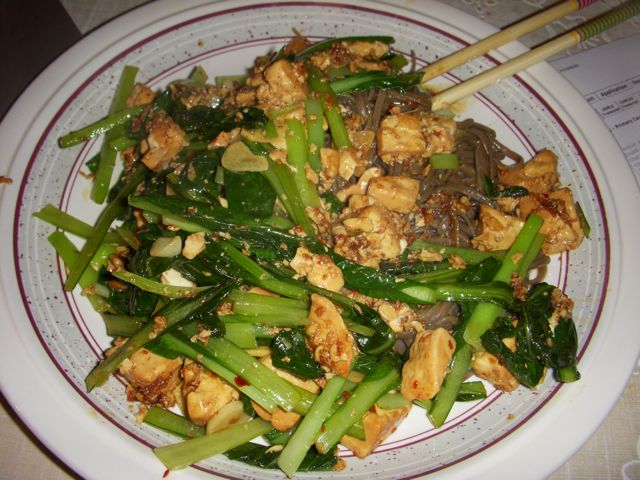
Now for something from a very different part of the globe, here is the really delicious tofu and bok choi stir fry (or as they call it here, pak choi). This recipe is super easy, and it confirmed for me that it is *always* better to marinate the tofu before cooking it, preferably with ginger and plenty of chilli. They say to serve it with rice, but I think I'm speaking for everyone when I say that noodles are better.

Hmm...lets see. If you have a garden and are still drowning in late-season zucchini (or courgette, as they say here. and in France), we really, really liked this recipe. Even if you aren't drowning in zucchini, we still liked this recipe :) Jamie Oliver is one of my heros - teaching people how to make delicious food, campaigning (and winning!) for healthier food in our schools...all good things. I'm especially pleased that our photo kinds sorta looks like the photo that goes with the recipe (except with worse lighting - stupid basement!)


Okay, now we're moving on from recipes I can easily link to, to recipes that I actually have to type out. First, Ottolenghi's cauliflower and cumin fritters (you'll notice that we've gotten a bit obsessed with this guy - gay Israeli with an Italian dad, trained at Le Cordon Bleu who states in his cookbook "If you don't like lemon or garlic...skip to the last page". What's not to love?). Seeing as they're just brown patties they don't photograph all that well, but just imagine the creamy, nutty taste of cauliflower, mixed with parsley and cumin and fried in oil, and you'll see why we were so eager to make them. Also on the plate is something I affectionately refer to as "vegetarian mush", which takes on many, many forms. In this case it consists of red lentils, some kind of winter squash, and samphire. We made it for Rosh Hashanah, but it would also be good for Hannukah alongside other fried goods. Sorry for the metric measurements, but this website seems to have good conversions.

Ingredients:
1 small cauliflower
120g plain flour
3 tbs chopped flat-leaf parsley
1 garlic clove (um, or 3)
2 shallots, finely chopped
4 free-range eggs
1 1/2 tsp ground cumin
1 tsp ground cinnamon
1/2 tsp ground turmeric
1 1/2 tsp salt
1 tsp black pepper
500ml sunflower oil for frying

1. Bring a pot of salted water to a boil. Trim the leaves off the cauliflower and snip into small florets. Add to the boiling water and simmer for 15 minutes or until they are very soft.

2. While the cauliflower is cooking, mix the flour parsley, garlic, shallots, eggs, and spices in a bowl and whisk together until smooth. Add the soft cauliflower and mix to break down the cauliflower into the batter.

3. Pour the oil into a wide pan to a depth of 1.5cm and heat until very hot. Carefully spoon in about 3tbs of the batter per fritter. Take care with the hot oil! Fry in small batches for about 3-4 minutes a side, until they are brown but not burnt. Enjoy the sound of the spattering oil!

4. Let each fritter try on a few paper towels, and serve with plain yogurt (to which you can feel free to add lemon and cilantro!), if you want.


Hungry for more fried cauliflower? I know, I know, who isn't? We've also tried this fried cauliflower with tahini sauce, which is amazing. Ottolenghi has brought tahini into our lives as something more than just an ingredient in hummus. It's another recipe that doesn't photograph well, but you can imagine. Fried food becomes healthy when you eat it with salad, right?


If fried food isn't your thing (but be honest...fried food is everyone's thing), this spinach polenta topped with tomatoes is a bit lighter but equally delicious meal that comes from a collection of Moosewood recipes we brought with us, courtesy of Danny's mom. The tomato topping doesn't call for red onion, but I added some and is was delicious, so I'll give it to you that way. This recipe makes a lot - I was eating it for breakfast for a few days!

Polenta Ingredients:
2 cups water
2 cups milk
1 tsp salt
1 cup polenta cornmeal
1 cup grated parmesan cheese
8 or more ounces fresh spinach (baby, or chopped large-leaf)

Topping:
4 large tomatoes or 8-10 plum tomatoes
1 large red onion
2 cloves garlic
2 tbs olive oil
1/2 tsp salt
1 tsp dried oregano
2 tbs balsamic vinegar

1. In a saucepan, bring the milk, water and salt to a boil. Add the cornmeal in a slow, steady stream while whisking. Simmer about 5 minutes, until the polenta is thick.

2. Meanwhile, dice the tomatoes and onions, and chop the garlic into small bits. In a saucepan on medium-high heat, heat the onions until they are soft, then add the garlic for a minute. Add the tomato and the rest of the topping ingredients and simmer for about 5 minutes.

3. When the polenta is thick, reduce the heat to low and stir in the cheese until melted and smooth. Fold in the spinach until just wilted. Serve the polenta hot topped with the tomato mix.


If you're looking for a really delicious side dish (or main dish, in our case), look no further than this simple but scrumptious grilled broccoli recipe, again from Ottolenghi.

Ingredients:
2 heads broccoli
115 ml olive oil
4 cloves garlic, thinly sliced
2 mild chillies, thinly sliced (or hot chillies, if you like!)
coarse sea salt and black pepper
optional: toasted flakes almonds or very think slices of lemon to garnish

1. Separate broccoli into florets. Fill a saucepan with water and bring to a boil (enough water to accommodate the broccoli easily). Thrown in the broccoli and blanch for 2 minutes only - don't be tempted to cook it any longer! Transfer to a bowl of ice water to stop the cooking. Drain and allow to dry completely. Once it is dry, mix with 45ml olive oil, salt and pepper.

2. Place a ridged griddle pan over high heat (or a pan in the broiler) and leave for 5 minutes, until it is very hot. Grill the broccoli, in several batches if necessary (the broccoli must not be cramped) until the have char marks.

3. While grilling the broccoli, place the rest of the oil in a small saucepan with the garlic and chillies. Cook over medium heat until the garlic just begins to turn brown - don't let it burn!

4. When all the broccoli is cooked, mix it with the chilli/garlic oil and toss. Season to taste and garnish as desired.


Okay, now on to the things that don't have recipes at all. First there is the cranberry bean stew, or at least that's what I'm calling it. In the US they are called cranberry beans, but here they call them Borlotti beans. Usually you buy them in cans but our farmers market sells them fresh, which is awesome because they are so beautiful! I think what I did here was 1) saute 2 medium onions in olive oil until they were soft, then 2) add about 3 large tomatoes, chopped. Once the tomatoes were soft I 3) added the beans and 1/2 teaspoon of salt, then let this cook for at least 30 minutes until the beans were soft and the onions were delightfully caramelized. This was really easy, and really, really delicious. The onions were so sweet it was practically dessert.

We rounded it out with some kind of scary-looking purple cauliflower and anemic looking corn. Apparently corn is meant to stay in the Americas, because this stuff is pretty bad. The cauliflower, though, was very good despite it's bizarre appearance. We blanched it in boiling water, coated it with olive oil and salt and pepper, then threw it under the grill/broiler until it was cooked through and getting brown (like the above-described grilled broccoli). Then we tossed it with fresh lemon juice, which is when it took on the magenta color.


Then there's our go-to recipe for green things. When in doubt, we saute some onions/garlic/leeks in olive oil (or occasionally butter if we're feeling decadent), then throw in the greens (sometimes we blanch them first if they seem a little tougher) and cook until they turn an edible texture. With some salt and pepper, it's hard to go wrong. Here we have runner beans on the left, and spring greens on the right.


Enjoy!

Wednesday, October 6, 2010

Typical Danish Weekend

RPOTD:


The fact that this saying is used by physicians everywhere for some reason makes me feel better about the future of the world.

Another thing that makes me feel optimistic: Denmark. Sometimes all the right-wing opinions out there somehow wiggle their way under my skin and make me start to question some of my core political beliefs: is nationalized healthcare really the way to go? are higher taxes for the wealthy just a punishment for doing well? is a welfare state just an invitation for people to be lazy? is Obama really orchestrating a systematic dismantling of America we as we know it just for his own political gain? Okay, so I never actually entertain that last one, but the Right is just yelling so loudly sometimes that I find myself wavering. But 4 days in Denmark was enough to confirm my belief that moving towards socialism is a good thing. This isn't meant to be a blog about socialism, or the welfare state, but it is going to talk about the awesomeness of Denmark, with hints about what enables it to be so awesome (spoiler alert: the answer is usually "taxes").

So first some background: why did we go to Denmark? it's not because we love pickled herring or pork, that's for sure (although I do love pickled herring). I studied abroad in Denmark in spring 2003 (if you can call that weather "spring"), and in addition to getting to love Copenhagen, I also lived with a really great host family and we wanted to visit them. Also, since I was there my host sister had a baby, and I wanted to meet her Danish toddler (verdict: just as cute as most toddlers, but speaking Danish!).

The very short version of our weekend was that we spent Friday in Copenhagen and stayed with Catrine (one of my host sisters) and her boyfriend Christian that night. The next morning my host parents, Ghita and Henrik, brought breakfast over and we all had a nice breakfast together (Oh, how I miss Danish breakfast! Dark bread, rolls, several kinds of cheese, jam, chocolate, butter, occasionally soft boiled eggs, and tea.). We spent the rest of the weekend staying with them in the small town of Jyllinge, on the eastern shore of Roskilde fjord, exploring the surrounding area, and visiting with Camilla, Kasper and the above-mentioned Danish baby. On Monday I went to work with Ghita for the morning, who is a nurse in a primary care clinic (but more on that later), then we spend the afternoon back in Copenhagen before flying home. It was a great weekend!

Okay, now on to the meat of the post, which is my impressions of Denmark. First, it was really interesting for me to be back in Denmark as an adult. When I was there before I had never lived on my own, didn't really think about politics at all (I think most of us were trying not to in spring 2003), hadn't traveled much, and probably didn't fully embrace the experience because I was thinking of a boyfriend back home. Also, it was always cold and windy, so I literally spent the first 3 months with my head down. This time I was much more aware of some of the things that make Danish people think they live in the best country in the world (*especially* better then Sweden), and I started to think about why those things are the way there are.

1. Bikes. It is impossible to talk about Copenhagen without talking about bikes. They are simply everywhere, and ridden by everyone. There are a few factors that make this possible/encouraged. One is that it is flat. Really, really, flat. So you can easily bike across the city without breaking a sweat (okay, so it's a small city, but still). Also, cars are expensive - really, really expensive. Or more accurately, the car is the normal price, but you pay around %200 in taxes. Many jobs will provide you with a company car, but for everyone else cars are just too expensive (though starting soon you will be able to buy an electric car and avoid the taxes, as an incentive to buy an electric care, which may be "powered" by wind). But importantly, the city doesn't just hang people out to dry: biking is a very viable option in cities because there are bike lanes along all the major streets. And when I say bike lanes, I don't just mean a magical line of paint that is somehow supposed to defend bikers from massive SUVs and MBTA buses. I mean an elevated, smooth lane on the side of the road. Like a sidewalk for bikes. And of course, there is a separate sidewalk for pedestrians. Copenhagen also boasts a good bus system, a train system, and most recently a sleek, fast metro system that is currently being expanded. All of this means that there is a minimal number of cars in the city, which makes it much more pleasant to walk around.

2. Family support. My host sister Camilla is getting her master's degree in urban planning/landscape architecture, rebuilding her new fixer-upper house, painting beautiful paintings, making homemade jam, and raising the adorable danish child along with her partner Kasper. And she seems to be doing it with ease. How is this possible? Mostly it's her own dedication and focus, but it's made easier by the country she lives in. For one thing, when both she and Kasper were in school, childcare was free. Free! At whichever local daycare they wanted! There is an income level under which childcare is free, and unsurprisingly the income of two students is below that level. Which is not to say that they don't have income: in Denmark college tuition is paid for by the government, plus students get a stipend to pay for their living expenses. Many students also work a few hours a week so they can have some spending money, but isn't that amazing! No student loans! No $150,000 of debt if you want to be a doctor! Another factor that makes it easier for women to have children during school is that their concept of the usual path of education is much more fluid. Many people take a gap year to travel or volunteer between high school and college, or maybe go to one year of another kind of school. It's much more acceptable to take time off while you take classes, or just delay the progress of classes. So Camilla thinks it was wonderful to have a child during school, because she could just take time off from classes then restart when she wanted.

This is a big deal for a lot of reasons. It makes sense to make having children compatible with education, so women who have children on the younger side are not discouraged from continuing their education. And conversely, it makes sense to make it easier for women, should they want to, to have babies when they are younger. It's very clear that there are health problems that arise when women who have children later in life, and it's harder for them to get pregnant in the first place. Now, there are many reasons that people in the US and Western Europe are having children later that are unrelated to education and cost of childcare, but it is certainly a big factor.


3. Unemployment support. This was relevant while we were there, because Henrik's company was in the process of laying off a 3rd of their employees. This was very upsetting to him, because as it's a company of 62 people, he knows all of these people personally. And he had to do some of the laying off, which, while better than getting laid off yourself, still sucks. But this reminded me of a Planet Money piece on Denmark that we heard back in the spring. If you have time you should listen to it, but if not, I'll give you the unemployment-related summary. In Denmark, unemployment benefits are high, and they last for a long time, so 1) people are less concerned about losing or leaving their job, and 2) companies are less concerned about having to lay people off, so they're more likely to take a risk on hiring a bunch of new people as soon as they have the capability. Oh, also, if you lose your job you still have health insurance because the government provides it. So people in Denmark, by the end of their working lives, have usually worked more jobs than your average person in the US, either by choice or not, but they haven't had to stop going to the doctor or work 3 low-paying part time jobs to make up for their lost income. So people may call is Socialism, but freedom to not be afraid to leave your job, for companies to not be afraid to hire people quickly...that sounds like the free market to me.


Okay, that's all the economic-related stuff I wanted to talk about, but before I move on I of course have to address the elephant in the room, which is how all of these nice things - the flashy, expanding metro system, the well-maintained bike lanes, the tuition and childcare support, the health insurance, and unemployment benefits are paid for. Taxes. Massive, massive taxes. The 200% tax on the car is a good example. They also have a 25% VAT, and their progressive income tax system maxes out around 50%. Obviously there are some people in Denmark who are less than thrilled with this system, but as the Planet Money piece suggests, most of them are pretty okay with it. It's just the Danish way of life - you get to keep less of your income, but most of it comes back to you in benefits. And you get the satisfaction of knowing that the economic systems of your country does not result in people living out of their cars or not being able to afford to feed their families when they lose their jobs, or get pregnant while they're still in school.


In addition to all this, there was just a certain *something* I felt on this trip to Denmark that I couldn't put my finger on. Scandinavians have a reputation for being not very friendly (How do you spot an outgoing Swede? He looks at your feet.) But our experience on this trip was the opposite. I was impressed with just how much my two host sisters had grown up to be just as gracious, honest, caring and curious as their parents. And I think if you asked them they would say that they are just a typical Danish family. There was always a plentiful stream of food and tea and snacks, which is just how I remember it from when I was there (but incidentally, they are all in great shape) - even at the primary care clinic they schedule a 30 minute break in the middle of morning so people can get caught up on their work and appointment, and during this time someone brings in a loaf of fresh bread and a block of cheese. Everyone at the clinic was really eager to meet us - Danny sat in the conference room and read, and he says that he probably spent a 3rd of his time talking to the doctors who would pop in to chat with him (mostly one doctor, Hans Christian, who had just been on a trip to the US recently). Also, people were very interested in Danny's dissertation topic, as Denmark has a lot of parallels to England in the current state of religion. They really wanted to discuss the issue, to hear what he was learning. We talked about this a bunch over drinks on Friday night, and I think the term "path dependency" was thrown around, and not by one of us. Did I mention that they all speak really, really good English? Catrine goes to Copenhagen Business School, where all of her classes are in English - she even takes notes in English!

Beyond the friendliness to us, there is just a certain embracing of life that I found very impressive. They live in a cold, dark country, and they've really made it their own. Fashion is focused on thick tights, long wool scarves, multiple layers, and big sweaters. I've never seen so many stylish people riding bikes in bad weather in my life! They even manage to look stylish in outwear, thanks to the prevalence of Helly Hansen jackets. They put a lot of effort into decorating their homes to create a welcoming, relaxing and comfortable atmosphere. One of the first things my family explained to me when I got there was that "Italians all have nice verandas, we all have nice living rooms." They light candles as soon as it gets dark and have them all over the house, something I had forgotten about but was immediately reminded of how nice it is. All of this works together to create the feeling that the Danes describe as "hygge". They insist that there is no appropriate English translation, but the closest thing is "coziness", maybe with a sense of "togetherness". There's also a real sense of national pride, and not a snobby national pride like of other European countries, but a pride in what Denmark has accomplished and created. They're proud of everything from traditional food, to the history of the Vikings (except maybe not the pillaging), of the many kings Christian and Frederick and their contributions to the country, to the ultra-modern danish design and architecture.

I'm not sure how much this general happiness is related to the so-called welfare state (or maybe the general happiness makes them a more gracious population who is willing to support a welfare stats?), or maybe the two are unrelated. And all I can say is, I want to go to there.

Tuesday, October 5, 2010

A weekend in Salzburg and Munich

It doesn’t look as if we’ll have time to blog in any substantial way about our trip to Salzburg and Munich, so here are some pictures to suffice.

Becca, cycling along the Salzach.  With no helmet, but in a dedicated bike lane, so she’s not nearly as unsafe or reckless as she looks.

Brunch at Café Tomasseli in the Altstadt.  At first, our waiter looked very concerned about our request for vegetarian food.  But when we insisted that an omelet without meat (and plenty of Käse) would be fine, he happily obliged.

A view of the city from the fortress.

A view of the cathedral and fortress from Schloss Mirabell.

Salzburg’s cathedral.  The interior has too much stucco decoration for my taste, but the exterior is pleasantly restrained.

That’s right.  Nine different kinds of pretzels.

Salzburg through a stein of Stiegl.

Becca enjoying said stein of Stiegl.

View from Nonnberg Abbey.  Climb ev’ry mountain…

No comment.

We spent the better part of our time in Munich drinking these beers.  As you can imagine, a liter of beer takes time.

Obligatory stop at the Hofbrauhaus, even though we didn’t have time for more beer.

So… beer, mountains, and churches.  A good way to spend a weekend.

Wednesday, September 29, 2010

To tide you over

Yeah, I know we haven't been blogging so much recently (especially Danny!), but it's with good reason - our parents were here! Now that their excellent visits have come to an end we hope to get back to semi-regular blogging...but not before a quick trip to Denmark to visit Familien Jacobsen. In the meantime, here are some pictures of Beppe and Nanni, just in case anyone was worried about their well-being in our absence. I think you'll find that living with Sam and Katie suits them just fine :)

Monday, September 20, 2010

But on the other hand...

...it still is your grandfather's England.

(Slight divergence for RPOTD:


Mike was here! We met up in Salzburg where he was attending a prion conference, then we took a quick swing through Munich to drink beer by the liter, then he hung out with us (and my mom!) in London for a day. It was excellent!)

But back to your grandfather's England. In many ways, England still exhibits that quaint, slightly stodgy charm that Americans expect from the home of Shakespeare and Jane Austen. For example, last week I took a day off work to explore the southwest edge of London with my mom. First we explored the truly magnificent Kew Gardens, which features some of the oldest greenhouses in Europe, all full of flowering plants and other greenery from all over the world. There is also an excellent butterfly room. There is nothing that makes you appreciate the fragility of living things like looking at a butterfly up close.

What really struck me about this day, however, was the visit to Richmond, where we walked along the Thames and got afternoon tea. Here we were, sitting within the bounds of London, a city of 8 million people, and we had this view:
Okay, so it's hard to tell because of the glare of the window, but there are cows in that field. Cows! In London! My mom wanted to experience the English countryside, and it turns out we could get there on the tube.

Also amusing were the two men in suits discussing Somerset's unfortunate season in county cricket (despite another solid season from Trescothick), while enjoying coffee with biscuits. And they ordered the biscuits specifically. If there's one thing that ties all Englanders together, it may be a love of biscuits. All hotel rooms come with a small packet of these crunchy treats. At my conference in Oxford there was a break for tea and coffee every 90 minutes (!), which was always accompanied by a wide assortment of biscuits. The cafe around the corner served Danny a solo cup of tea, then came around to the table to offer him several fresh-baked ones when they came out of the oven. I've heard grown men grumble when their tea is served without an accompanying biscuit. And so on.

This is just a few small examples, but I think the love of biscuits and the proximity of cows to central London are good examples of how England has maintained a delightfully antiquated charm while still galloping along with the pace of the modernizing world. And just for the record, lest anyone think I am being judgmental, I love biscuits, too. I also love afternoon tea!

UPDATE FROM DANNY: For, perhaps, the best bit of biscuit humor I've ever seen, here's Rob Brydon on Would I Lie to You.

Sunday, September 19, 2010

Sports-related pub discovery #2

It turns out that the Sky Sports feed at the Dartmouth Arms is German - straight after Chelsea-Blackpool finished, on come what appeared to be the Straubinger Tigers-Augsburger Panther game.  So for you forlorn Deutsche Eishockey Liga fans in London who can't get your fix, make your way to Dartmouth Park!

Saturday, September 18, 2010

Not your grandfather's England

Today's random photo is a lead-in to the topic of today's blog:


This is from when Jessica was visiting last month! That evening we got pre-dinner at Harrods: an enormous gelato sundae at Morelli's, one of the many tasty eateries in their famous food hall. One thing that jumped out at me when as I scanned the rest of the people happily enjoying candy-covered ice cream, was that based on the dress of the women, everyone around us seemed to be Muslim. And there were interesting touches that reflected this Muslim predominance around the rest of the store, like the Arabic signs indicating which chocolates are alcohol-free, for example. One possible explanation for this is that Harrods in particular attracts a Muslim clientele. It was owned by Mohamed Abdel Moneim Fayed, an Egyptian businessman, from 1985 until 2010, when it was bought by Qatar Holdings.

But for someone who has lived the past 4 years in Brookline, Harrods is not the only place that the large number of Muslims living in and visiting the UK is apparent. As soon as I got off the plane at Heathrow, I saw more women in headscarves and varying types of Hijab at the arrivals gate than I had probably seen in my whole life up until that point. One of the Pope's assistants made a similar point before the recent papal visit, although his take was decidedly un-PC. For my research at the Trop I've been looking as some local public health reports, and was impressed by the number of websites (especially in places like London and Birmingham) that featured articles like "Guide to a healthy Ramadan" and "Controlling your diabetes during Ramadan." In many neighborhoods the streets are lined with Halal grocers and delicious-smelling kebab shops.

The obvious presence of Muslims living in London got me to thinking about the US, and the rampant anti-Muslim sentiment running through the population right now. I don't have any data to back this up (but I'm sure it's out there), but it seems to me that most of the anger/hatred/fear stems from people who don't actually have that much contact with Muslims in their daily life, simply because they live in parts of the country where there aren't that many Muslims. I think a good example of this is that is wasn't New Yorkers who raised the crazy opposition to the lower-Manhattan cultural center. And because there are many people who don't see Muslims on a regular basis, the right-wing pundits that been able to convince them that all Muslims are dangerous and stand for the destruction of America. I'm not saying that the UK doesn't have any problems with anti-Muslim feelings - obviously simply mixing populations does not cause immediate understanding and acceptance. It's an incredibly complicated issue. I guess my point is just that if the pastor in Florida had seen more Muslim families enjoying ice cream sundaes and peacefully celebrating Ramadan, he might not have been driven to burn their holy book.

Thursday, September 9, 2010

Academia, England-style

Random Photo that Danny thought was funny:

Oxford may only be the 6th best university in the world (thanks, Stephen, for posting the link), but it's still an amazing place for a weekend trip and conference! Thanks to my cushy connections at the LSHTM, I got to attend a Health Policy conference earlier this week, held at Madgalen College in Oxford. The conference was Monday and Tuesday, but Danny and I headed out on Sunday morning to see just how Oxford compared to Cambridge (which, incidentally, just leaped over Harvard for best university in the world). Although the hands-down verdict is that Cambridge is better (I mean, who punts from inside the boat?!), we had a great time. Highlights of the visit included:

- Visiting Christ Church (which is a college, not a church, although it does have quite a large church), where some scenes from Harry Potter 1 and 2 were filmed, and where Charles Lutwidge Dodgson was inspired to write Alice in Wonderland. Alice was the young daughter of the dean of the college. Every night after dinner the dean would leave via a hidden door and back staircase - the white rabbit was based on him. Alice also had a cat named Dinah who would sit in a tree next to the library.

- Listening to bees. Just so you're assured that Oxford does have a hippy-dippy side, we visited a socio-ecological project where a guy has set up 2 bee hives, with a stethescope in each one so you can sit and listen to the bees doing their thing. It was pretty cool.

- Cream tea

- Dinner at one of Jamie Oliver's Italian restaurants. Tired of going to pubs and finding just one veggie option, we splurged for some home-made Italian goodness. And it was good.

- The Ashmolean museum: art and old things.

- The Museum of the History of Science. Lots of beautiful, hand-made astronomical tools that I don't understand, the original 1940 journal describing the use of penicillin (not that long ago!), several of Marconi's first radios, and a chilling display of the first anesthesia delivery system from the 1840's next to a bone-saw kit from the late 1700's. Ouch.


But it wasn't all fun and games and tea (although we did buy a new game, and we did drink a lot of tea). We were also there to learn. While Danny went to the Bodleian library to read the records of the conservative party, I began in earnest my foray into the social sciences. It was really great to think about the more large-scale aspects of health, rather than just how we treat diseases. Topics ranged from the fairly straightforward (do policies to include patients in safety efforts work, and what determines whether patients want to get involved) to the obscure-but-thought-provoking (focusing on social governance and the fate of all humanity rather than politial and economic gains).

The keynote address happened to be by Ted Marmor, on the recent health care reform in the US, and how we managed to get a "Republican style" plan that no republicans voted for (answer? US senate structure. and some other stuff). But he is hopeful that some of the new laws regarding private insurance may pave the way towards more universal, if not single payer, health care.

Another point that was driven home in this conference is that in the UK, health care policy changes all the time. Yes, the NHS has been in place since 1948, but they (politicians) feel the need to make some slight change every 2-3 years - changing the details GP contracts, changing public health priorities, changing the flow of money. All of which of course means that there's very little time to evaluate policies, and everyone does so under the assumption that they will just change in a few years away. And doctors have just gotten used to the idea that while the policies change constantly, once the dust settles they will go back to practicing medicine as usual. Whether that will be the case with the new White Paper, though, is anyone's guess. But more on that later. For now, it's off to Salzburg!

A day at Lord's

We had hoped to go to the 5th day of the England-Pakistan Test at Lord's.  You know, the one in which Stuart Broad cemented his place as a real Test batsman.  But as it turned out, the Test finished halfway through the 4th day, with the shadows of spot-fixing allegations hanging over the Pakistan team.  So our hopes to see Test cricket at the home of cricket were dashed.

Instead, we opted for a rather less significant match: a Pro40 one-day match between Middlesex and Derbyshire last Saturday.  Last Saturday was a pleasant day, so why not spend it outside?

The match itself was a pretty tame affair: a 7-wicket win for Middlesex, with little sense of any other possible result for most of the afternoon.  So rather than you a rather boring recap of the game action, here's a series of observations about watching a domestic cricket match at Lord's, the home of cricket on a Saturday afternoon in late summer.

But first, evidence that we were there:

Becca with the Media Centre.


Danny with the Pavillion.


- Beer is cheap.  Well, cheap by pub standards.  You're going to pay £4 for a pint of ale, whereas I think the priciest pint in a pub I've had in London is somewhere around £3.60.  But given that you're at a professional sporting event, £4 is dirt cheap.  Those of you who have been to Fenway recently know how much beer at a baseball game will set you back.  And remember, here in England it comes in pints.

- People dress up to watch cricket.  I suspect that this is much more common at Lord's (with its connection to the Marylebone Cricket Club, a sort of old-fashioned gentleman's club with a special interest in cricket), but still, it's rather striking to view to see dozens of men dressed in blazers and ties while drinking beer on a Saturday afternoon.

- Some of the best players in the world play before small crowds in domestic matches.  I can't find any attendance figures for the match we went to, but I'd say that there were no more than 1,000 fans in attendance, most of them clustered together on one side of the pitch.  This, in spite of the fact that England captain Andrew Strauss turned out for Middlesex.  It was a bit of a shock to see him fielding, rather anonymously, at square-leg, just 15 meters away from us.

- Speaking of close contact with England players, we happened to find ourselves just a few steps behind fast bowler Steven Finn as we wandered around the stadium.  At first I thought it was just a fan wearing the Middlesex kit.  But we quickly realized that there aren't many fans that are 6'7".  So there he was, just walking back to the dressing room as we wandered back to our seats.

- Pimm's and Lemonade on tap!

If you happen to be in London this weekend and want to see English cricket at its amateurish best, the final of the Village Cricket Cup is at 11:00 on Saturday morning at Lord's.  Shipton-under-Wychwood versus Sessay for all the marbles.

Historians' quest for context in the archive

What do you do when you find the same sort of letter over and over again in the archives?  Like, say, this one:

I'll return to this letter in a minute.

Historians are big on context.  When teaching undergraduate students, this can be as basic as developing reading skills: Be sure to read around the passage or phrase you're interested in to make sense of it.  Be skeptical of claims based on quotations that seem too good to be true.  Things get more complicated when you consider the full document that a quotation is drawn from.

At another level, historians are interested in the circumstances in which events occur and ideas develop.  Unlike scholars in some disciplines who seek out "master factors" that explain everything, historians are suckers for making sure their stories incorporate lots of contextual information.  At its worst, this can degenerate into mere description and lose any analytic rigor.  But at its best, this "quest for context" (as I've heard Robert Self describe historians' project) helps us gain a richer understanding of the complexity and diversity of the human experience.

Now, back to that letter (go ahead, click on it).  On first reading, it doesn't seem that promising a source for the historian of religious education.  It's on a rather mundane topic: who should pay for particular educational materials, the Local Education Authority (think school board) or individual "voluntary" schools (schools that received some state funding but remained under the control of third-party, typically religious organizations).  Letters that contain the phrase "requisitioned in the usual way" aren't exactly the sort of thing that inspire excitement.

If you read a bit more closely and realize exactly what sort of education materials are at issue, the letter becomes more interesting.  This isn't a letter about math textbooks or art supplies.  Instead, what the letter-writer wants to know is whether the LEA is allowed to buy prayer books for local church schools.  Now things are starting to get juicy, right?  You'd never see anything like this in the United States.  State funds going to purchase explicitly religious materials for explicitly religious schools?  Welcome to post-WWII England.

So far, so good.  But this is just one letter.  Perhaps the Isle of Wight education authority was just super-careful and wanted to make absolutely sure that they could pay for prayer books requested by voluntary schools (as the law in fact permitted them to do).

In fact, there are dozens of letters just like this in the records of the Ministry of Education.  So many, in fact, that you get a clear sense of just how exasperated ministry officials were getting with these information requests. After reading a few of these letters, I could practically write the replies myself, "The local education authority is required to provide the funds for regular education expenses for voluntary schools, including religious education, as long as the costs are reasonable."

It wasn't just the Isle of Wight, in other words, that was unsure about the regulations surrounding religious education in the 1944 Education Act.  Across England, education authorities pestered the Ministry of Education about what sort of religious education they could and couldn't pay for.  In some cases, it's clear that the LEA wanted to support the denominational voluntary schools but were uncertain if the law allowed them to do so.  In others, like the West Riding of Yorkshire, the education authority, more secularist in outlook, had to be leaned on rather heavily by the Ministry of Education to fulfill its statutory obligation.

But there's a thread that connects all these letters: the question of "denominational" education.  In letter after letter, you see the phrases "denominational instruction," "distinctive of any denomination," and the like.  A phrase that seems technical or mundane in just one letter assumes far greater import when it's inescapable. 

So I would argue that this letter only makes sense in the context of the dozens of other letters raising the exact same issue.  The existence of so many letters on one topic reveals something deeper than any single letter on its own can suggest: that there was widespread confusion and anxiety about what constituted "denominational" religious instruction in the immediate aftermath of the 1944 Education Act.  This claim can also be spun into a larger discussion of denominational conflict in the immediate postwar era (of which there was plenty).

The historian's task, then, is more than just collecting a series of texts and reporting on their contents.  Historians have to look for connections across documents.  And it is those connections that allow the historian to transcend the particularities of any given piece of evidence to make broader claims about the past.

Saturday, September 4, 2010

Bank Holiday Weekend

Finally took a photo of a Vegetarian Full English Breakfast. The lighting is weird because we were eating outside!


Last weekend (August 28-30th) was a bank holiday weekend. Why? Because, as my boss put it, "In the UK we actually get holidays, though not nearly as many as Continental Europe." In addition to the expected public holidays (Easter, Christmas, New Years Day, and the Queens Diamond Jubilee to be held in 2012), there are three Bank Holiday Mondays - two of which are inexplicably held in May (Early May Bank Holiday and Spring Bank Holiday), and one on the last weekend in August. How to celebrate? It was too late to make reservations to take a true vacation, since most of England plans a weekend getaway, but we did take a day trip out of London to the New Forest National Park.

The New Forest is a good example of the difference between natural beauty in the US vs. UK. While some parts of Northern England and Scotland and North Wales are impressive, much of English beauty is more...subtle. The New Forest would never be a National Park in the US. It is mostly open grass pastures with grazing cows, horses and ponies, interspersed with pretty forests and small towns with thatched roofs. But the great thing about the New Forest is the cycling trails - many miles of cycle-only trails, and plenty of pubs and tea rooms to keep cyclists refreshed. Just an hour and half train ride from London, it's the perfect day trip! You just have to be careful, because there are often ponies on the road, on the cycle trail, and just outside the pubs...


Sunday was unimpressive in terms of what we did, although we did check out a new farmers market, which is always exciting. On Monday we ventured down to the famous Notting Hill Carnival, which is held every August Bank Holiday. Apparently it's the "largest street festival in Europe", and I'd believe it. It's an impressive West Indian cultural festival, with a parade and some of the most spectacular costumes I've ever seen. It's also an impressive display of young Londoners' eagerness to get drunk in the middle of the day (you could buy shots at tables set up on the sidewalk), and their ability to tolerate huge crushes of people. We left relatively early to go play ultimate with Curve - we hadn't been in over a month! Then we came home and made Shakshuka. All in all a great weekend!